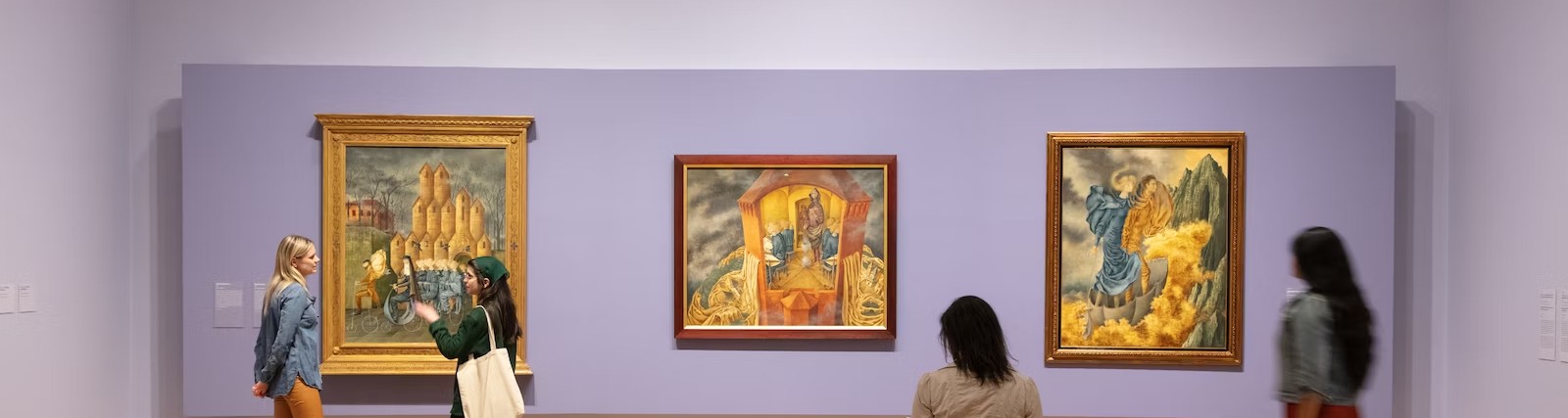
Remedios Varo was a Spanish-born artist associated with Surrealism who developed her mature painting career in Mexico City. Museum and encyclopedia sources agree on her birth and death dates.
Name, birth, and death
Her full name appears in museum and encyclopedia entries as María de los Remedios Alicia Rodriga Varo y Uranga (Art Institute materials sometimes print a closely related form of the same name). She was born on 16 December 1908 in Anglès, in the province of Girona, Catalonia, Spain, and died on 8 October 1963 in Mexico City of a heart attack, aged 54 (Britannica; NMWA; MoMA).
NMWA’s phonetic guide renders her name roughly as “ray-MAY-dee-yohs VAH-roh.” She is widely known simply as Remedios Varo.
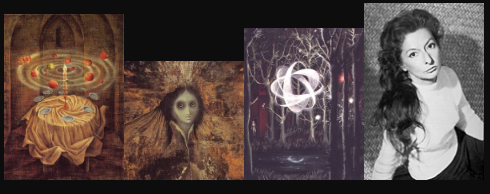
Childhood and Madrid training
Britannica describes a well-educated family. Her father, a hydraulics engineer, taught her technical drawing. His work required travel; the family moved through Spain and North Africa before settling in Madrid in 1917. In Madrid she attended Catholic school—NMWA notes she rebelled against its strictness—and then studied at the Real Academia de Bellas Artes de San Fernando. She graduated in 1930 with a degree qualifying her to teach drawing (Britannica).
Her childhood travels in Spain and North Africa took place well before the Spanish Civil War, which began in 1936. Hieronymus Bosch and other Prado holdings are often named among the visual influences she met as a student in Madrid; Britannica notes Bosch as an admired source for her later compositions.
Barcelona, Péret, and Paris
In the mid-1930s, while living in Barcelona, she involved herself in Surrealism and joined the avant-garde group Logicophobista (Britannica). In 1936 she met Surrealist poet Benjamin Péret; they fled Spain for Paris and married in 1937. In Paris they were absorbed into Surrealist activities: she exhibited with the group and published drawings in Surrealist publications (Britannica). MoMA notes a close association with Surrealist artists and points to an untitled 1935 collage made with Esteban Francés, Oscar Domínguez, and Marcel Jean using the cadavre exquis (exquisite corpse) technique.
NMWA states that she moved to Paris in 1937 and later found she could not return to Spain after the Spanish Civil War. As World War II threatened Paris, Spanish refugees came under threat; Varo was arrested and held in early 1940. After her release she fled Paris in the face of the Nazi invasion and, by late 1941, secured passage to Mexico (NMWA). Britannica likewise places the couple’s flight to Mexico in late 1941 to escape Nazi-occupied France.
Accounts of the wartime route emphasize flight from France to Mexico. NMWA and Britannica place her departure from Nazi-occupied Europe and arrival in Mexico City in late 1941.
Mexico City and mature work
In Mexico City, Britannica says, they connected with locals such as writer Octavio Paz and with exiled artists and writers including Wolfgang Paalen, Gordon Onslow Ford, and Leonora Carrington, who became Varo’s closest friend. Her first pursuits were commercial art, interior and costume design, and restoration of pre-Columbian pottery.
Britannica states she began to devote her time entirely to painting only in 1953, by which time she had separated from Péret and was involved with Austrian businessman Walter Gruen, who supported her painting. NMWA describes late-1940s commercial illustration as the period when her mature personal style began to form—two institutional timelines that overlap without contradiction: commercial work in the late 1940s, full-time painting from the early 1950s.
Her first solo exhibition in Mexico City in 1956 brought widespread recognition; crowds came, and demand produced waiting lists for commissions (Britannica; NMWA’s Magic of Remedios Varo page repeats the celebrity and waiting-list picture for that first solo show). She continued to exhibit and created the bulk of her work in the last ten years of her life (Britannica). MoMA estimates over 500 works by her death, most made in Mexico.
What her paintings are like
Britannica summarizes strange humans engaged in mystical and alchemical activity in dreamlike atmospheres, with architectural features that reference medieval art and show expert draftsmanship. Art Institute writing for Science Fictions adds disciplines as wide-ranging as chivalric romance, ecology, geographic exploration, feminist critique, mysticism, psychology, and tarot, joined to Surrealist chance-based techniques. NMWA’s note on The Call (1961) describes solemn quest imagery, alchemical tools, and a characteristic orange-gold figure against muted surroundings—useful as a concrete museum description of late style.
Death and afterlife of reputation
She died of a heart attack in 1963 as she was reaching new renown (NMWA). Britannica records a strong posthumous reputation in Mexico, including a 1971 Museum of Modern Art (Mexico) retrospective with record-breaking crowds, then slower international recognition until shows such as NMWA’s The Magic of Remedios Varo (2000) and the Art Institute’s Science Fictions (2023).
Britannica and NMWA record that she died of a heart attack in 1963.
Where to go next
Some popular accounts mention friendships with Frida Kahlo and Diego Rivera; Britannica’s short biography emphasizes European exile circles and figures such as Octavio Paz and Leonora Carrington instead. Separate pages expand early life, Paris and Surrealism, Mexico years, Carrington and Horna, major works, and exhibitions.
Sources
- Encyclopaedia Britannica, Remedios Varo
- National Museum of Women in the Arts, Remedios Varo
- NMWA, La llamada (The Call)
- NMWA, The Magic of Remedios Varo (2000)
- Art Institute of Chicago, Remedios Varo: Science Fictions
- MoMA, Remedios Varo artist page
- MoMA, The Juggler (The Magician), 1956