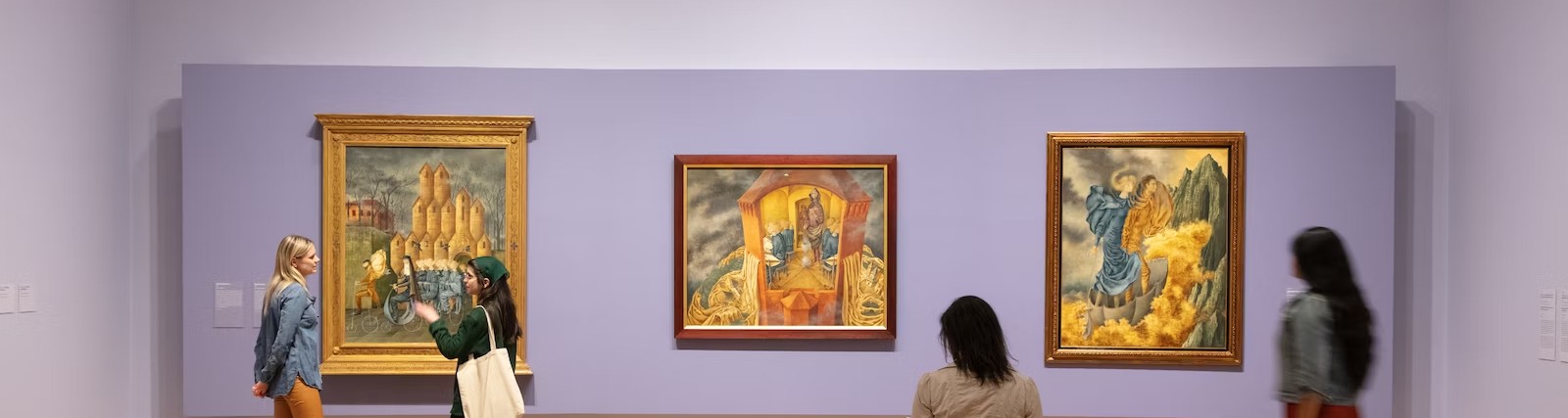
This page describes several well-documented paintings, with collection holdings drawn from museum and exhibition captions.
How to read the list
Titles appear in Spanish and English when museum pages publish both. Dimensions and media follow the holding museum’s published object data. Private-collection works shown in exhibitions are identified as private collections when that is what the museum caption says.
Creación de las aves (Creation of the Birds), 1957
Art Institute of Chicago materials for Science Fictions identify Creación de las aves as in the Museo de Arte Moderno, Mexico City (INBAL / Secretaría de Cultura). Curators describe a scientist-like figure at work with optical instruments, showing the productive powers of light dispersed by a prism. NMWA’s Magic of Remedios Varo text summarizes a related reading: an owl artist/musician uses synthesized materials to create a bird that takes flight out a window—an emblem of craft meeting metamorphosis.
The painting is central to discussions of Varo’s blend of science imagery and creative magic.
El juglar / The Juggler (The Magician), 1956
MoMA holds The Juggler (The Magician), 1956, oil and inlaid mother-of-pearl on board, 35 13/16 × 48 1/16 inches (91 × 122 cm), Gift of Joan H. Tisch (by exchange), object number 736.2018. MoMA’s gallery label (2024) describes a juggler or magician on the platform of a carnivalesque cart filled with fantastical objects and animals, performing before seemingly identical figures robed in a single gray cloak.
Technically, MoMA notes that Varo worked in the manner of early Renaissance masters: preparatory drawings transposed onto a gesso-primed panel scratched for surface variation, plus Surrealist decalcomania (paper, foil, or similar pressed onto wet paint) visible in garments and background trees. Art Institute conservators add that she reserved mother-of-pearl inlay for a small group of works, often to mark spiritual or enlightened figures, and that soufflage (blown thinned paint) appears in abstract blotches on this painting.
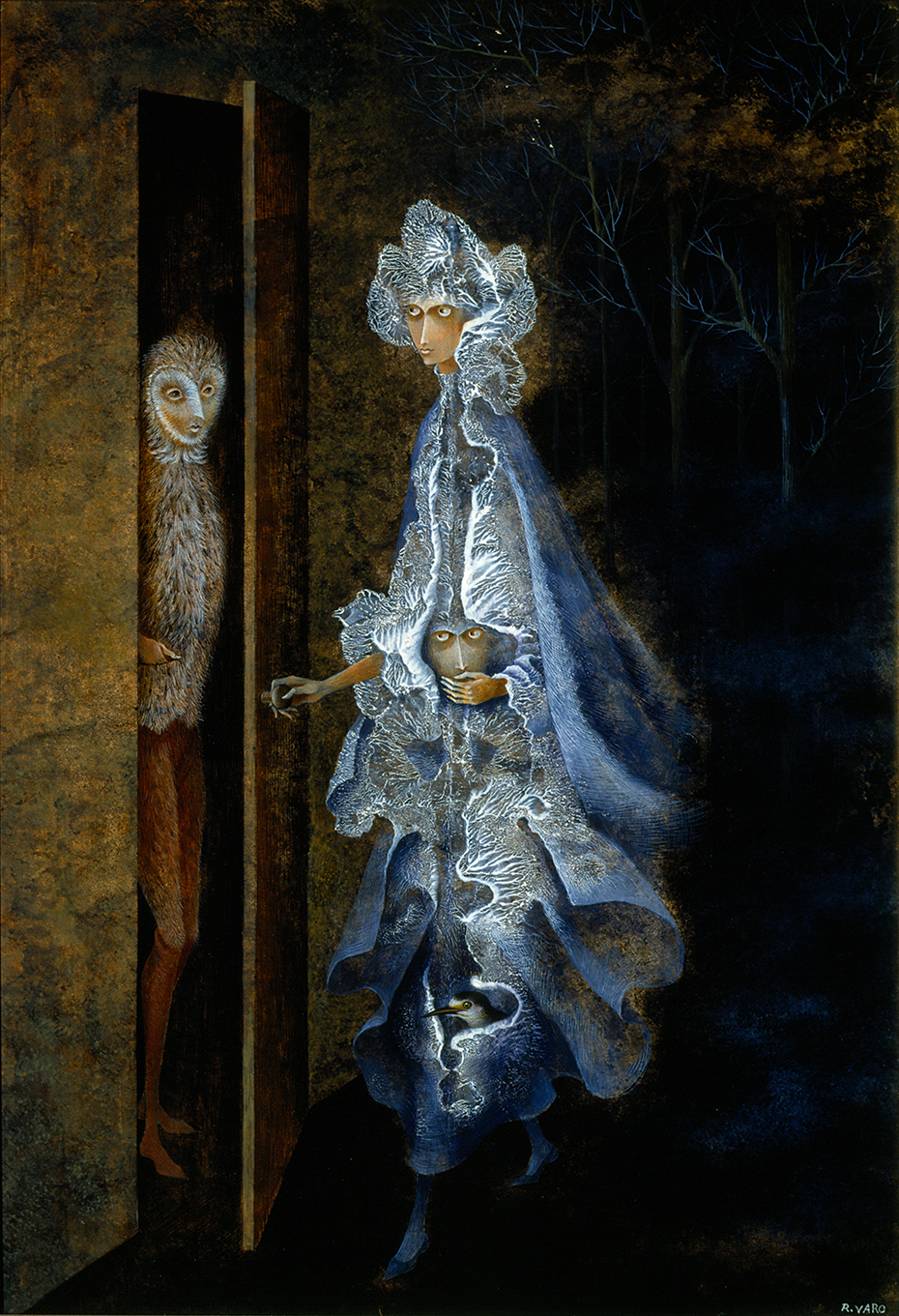
La llamada (The Call), 1961
NMWA holds La llamada (The Call), 1961, oil on Masonite, 42 × 31 inches, gift from a private collection. The museum describes a figure in flowing robes carrying alchemical tools—including a mortar and pestle at the collar—crossing a courtyard-like space. Hair forms a brilliant swirl of light that seems to draw energy from a celestial source. The palette is characteristic: fiery orange-gold on the central figure against shadowy, muted surroundings. Precise lines hide unexpected details, such as walls that appear to entomb figures in tree bark.
NMWA notes that Varo’s own features—large eyes, long straight nose—often appear in protagonists without making the works direct self-portraits; figures are frequently androgynous or not-quite-human alter-egos. The painting belongs to the end of her life, when her Mexican reputation was still rising.
Armonía (Harmony), 1956
Art Institute materials identify Armonía (also titled in related captions as a suggestive self-portrait) as in the Collection Eduardo F. Costantini. Curatorial notes quote Varo on a composer “trying to find the invisible thread that unites all things.” Britannica’s page has featured related imagery of this work in exhibition contexts (including a LACMA viewing during the 2012 In Wonderland show).
Ciencia inútil, o El alquimista (Useless Science, or The Alchemist), 1955
Art Institute captions place this work in Museo de Arte Moderno. Curators describe an alchemist using a spinning wheel to set off a distillation process—possibly aiming at quintessence or life force—with vapor that seems to generate the painting’s atmosphere itself. The canvas is a key example of alchemy as both subject matter and metaphor for painting.
Exploración de las fuentes del río Orinoco (Exploration of the Sources of the Orinoco River), 1959
Shown in Art Institute materials as a private-collection work: a cloaked figure in a boat-like vessel among watery architecture. Britannica’s biography page has also featured this painting in related imagery. A full-scale cartoon for the composition is documented at Museo de Arte Moderno; Art Institute conservators note that Varo sometimes kept developing cartoons after transfer, and that those drawings were not exhibited in her lifetime.
Other works named on museum pages
Art Institute essays and captions also discuss, among others, Simpatía (Sympathy) (1955, Collection Eduardo F. Costantini); Tauro (Taurus) (1962, Museo de Arte Moderno); El flautista (The Flutist) (1955, Museo de Arte Moderno); Cazadora de astros (Star Catcher) (1956, Toledo Museum of Art); Roulotte (Caravan) (1955, Museo de Arte Moderno); La huida (The Escape) (1961, Museo de Arte Moderno); Hallazgo (Discovery) (1956, private collection); and the triptych beginning with Hacia la torre (Toward the Tower) (1960, private collection). Holdings above are repeated only as the Art Institute captions state them.
NMWA and secondary catalogues often discuss Woman Leaving the Psychoanalyst, Embroidering the Earth’s Mantle, and Still Life Reviving. Prefer museum labels and the 2023 Art Institute catalogue for authoritative data on those works.
Seeing the works
Public collection pages at MoMA, NMWA, and Museo de Arte Moderno are the best next step for images and current display status.
Sources
- MoMA, The Juggler (The Magician), 1956
- NMWA, La llamada (The Call)
- Art Institute of Chicago, Remedios Varo: Science Fictions
- Art Institute of Chicago, The Dueling Dualities of Remedios Varo
- Encyclopaedia Britannica, Remedios Varo
- NMWA, The Magic of Remedios Varo (2000)
- INBAL press note on Museo de Arte Moderno Varo holdings
- Art Institute publication, Remedios Varo: Science Fictions catalogue