In Mexico City, Remedios Varo’s closest artistic friendship was with Leonora Carrington. Photographer Kati Horna belonged to the same exile community. Popular writing sometimes calls the three “the witches”; museum texts emphasize friendship, shared occult study, and collaboration.
Meeting Carrington
Britannica and NMWA both identify Leonora Carrington as Varo’s closest friend in Mexico. They had crossed paths in Paris Surrealist circles—Carrington was then connected with Max Ernst’s world—and reunited as refugees in Mexico City. NMWA calls Carrington her closest friend and collaborator. Art Institute authors, writing about magic recipes for dreams, name Carrington and Horna together with Varo as an inner circle of women friends who wrote such recipes to provoke specific dreams (erotic dreams, or dreams of being the King of England, in the museum’s examples).
That collaboration matters because it shows occult play as social practice, not only as private studio symbolism. It also shows feminist humor inside esoteric study: the recipes are inventive and witty, not solemn dogma.
Kati Horna’s lens
Kati Horna photographed Varo. NMWA’s artist profile credits a 1963 studio portrait of Varo by Horna, with rights noted to Norah Horna and image courtesy of Walter Gruen on the museum page. Horna’s presence anchors the trio in documentary photography as well as painting and writing.
Shared study: mysticism without a single creed
NMWA states that in Paris and after, Varo associated with Surrealists while exploring magic, alchemy, and analytical psychology. Art Institute essays detail alchemy books in her library (including F. Sherwood Taylor’s The Alchemists), astrological imagery, and interest in astrophysics such as Fred Hoyle’s The Nature of the Universe (1950). Names such as Gurdjieff, Jung, Ouspensky, Sufism, Blavatsky, and Meister Eckhart recur in Varo scholarship and circle anecdotes as interests of a milieu rather than a single doctrine behind every painting. Museum essays inventory alchemy books and related themes from her library.
Exile community, not a formal school
Britannica places Varo among exiled artists and writers in Mexico City—Wolfgang Paalen, Gordon Onslow Ford, Carrington, and others—alongside locals such as Octavio Paz. Art Institute text describes a fecund creative community of Mexican and European artists drawing on Mexico’s culture and geography. The Carrington–Varo–Horna friendship sits inside that wider map. It is not a charter for a named movement with officers and dues.
The popular “three witches” nickname appears in journalism about their occult interests. Museum wall texts and encyclopedia entries treat friendship and collaboration as the firmer ground.
What collaboration looked like
Beyond dream recipes, secondary scholarship discusses collaborative writing between Varo and Carrington. Institutional pages emphasize closest friendship, collaboration, shared Surrealist and esoteric curiosity, and Horna’s photographic record of Varo near the end of her life (1963 portrait).
How the friendship shows in the art
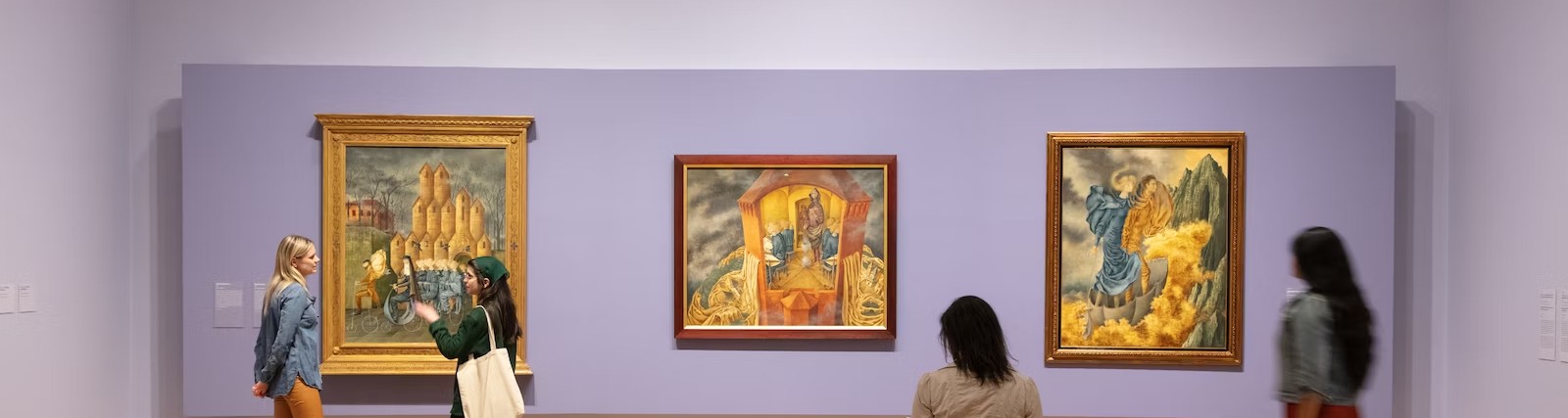
Museum writers describe thematic overlap: women protagonists on quests, alchemical tools, hybrid creatures, and rooms where science and magic share a table. NMWA’s discussion of The Call (1961)—androgynous or not-quite-human alter-egos with witty fauna features—fits that shared vocabulary of transformation.
Why the circle matters to viewers of the paintings
Knowing Carrington and Horna were interlocutors helps explain why Varo’s Mexico years feel socially dense even when a canvas shows a solitary seeker. Dream recipes, shared reading, and photographic portraiture are traces of conversation that Art Institute and NMWA writers describe with care.
After 1963
Varo’s death in October 1963 ended the daily friendship. Carrington lived and worked many more decades in Mexico; Horna’s photographs remain primary visual evidence of Varo’s studio presence. Legacy pages and exhibitions after 2000 often hang or discuss these affinities when introducing Varo to new audiences—without collapsing three artists into one biography.
Further reading on this site
Pair this page with themes and symbols (alchemy, magic, music) and Mexico years (timeline). For institutional shows that reshaped her fame abroad, see exhibitions and museums.
Timeline anchors for the friendship
Paris Surrealist acquaintance in the late 1930s; wartime rupture; Mexico City reunion after Varo’s late-1941 arrival (Britannica; NMWA; Art Institute). Full-time painting years from 1953 with Gruen’s support (Britannica) overlap the period when Carrington was also producing major work in Mexico—museum narratives often treat the 1950s as a shared weather system of esoteric study and inventive figuration. Horna’s 1963 studio portrait arrives at the chronological end, weeks or months around Varo’s final year (NMWA credit line: 1963).
Occult study versus Surrealist orthodoxy
Breton’s Paris circle valued the marvelous and the unconscious; Varo’s Mexico circle added recipe-like experiments, tarot, and alchemy books that Art Institute researchers inventory from her shelves. NMWA’s triad of magic, alchemy, and analytical psychology names the blend without forcing Jungian orthodoxy onto every canvas. Readers should expect playful rigor: crystal charging and prism optics can share a studio (Art Institute dualities essay) without canceling scientific curiosity.
See Mexico years, themes, and biography.
Sources
- Encyclopaedia Britannica, Remedios Varo
- National Museum of Women in the Arts, Remedios Varo
- NMWA, La llamada (The Call)
- Art Institute of Chicago, The Dueling Dualities of Remedios Varo
- Art Institute of Chicago, Remedios Varo: Science Fictions
- NMWA, The Magic of Remedios Varo (2000)